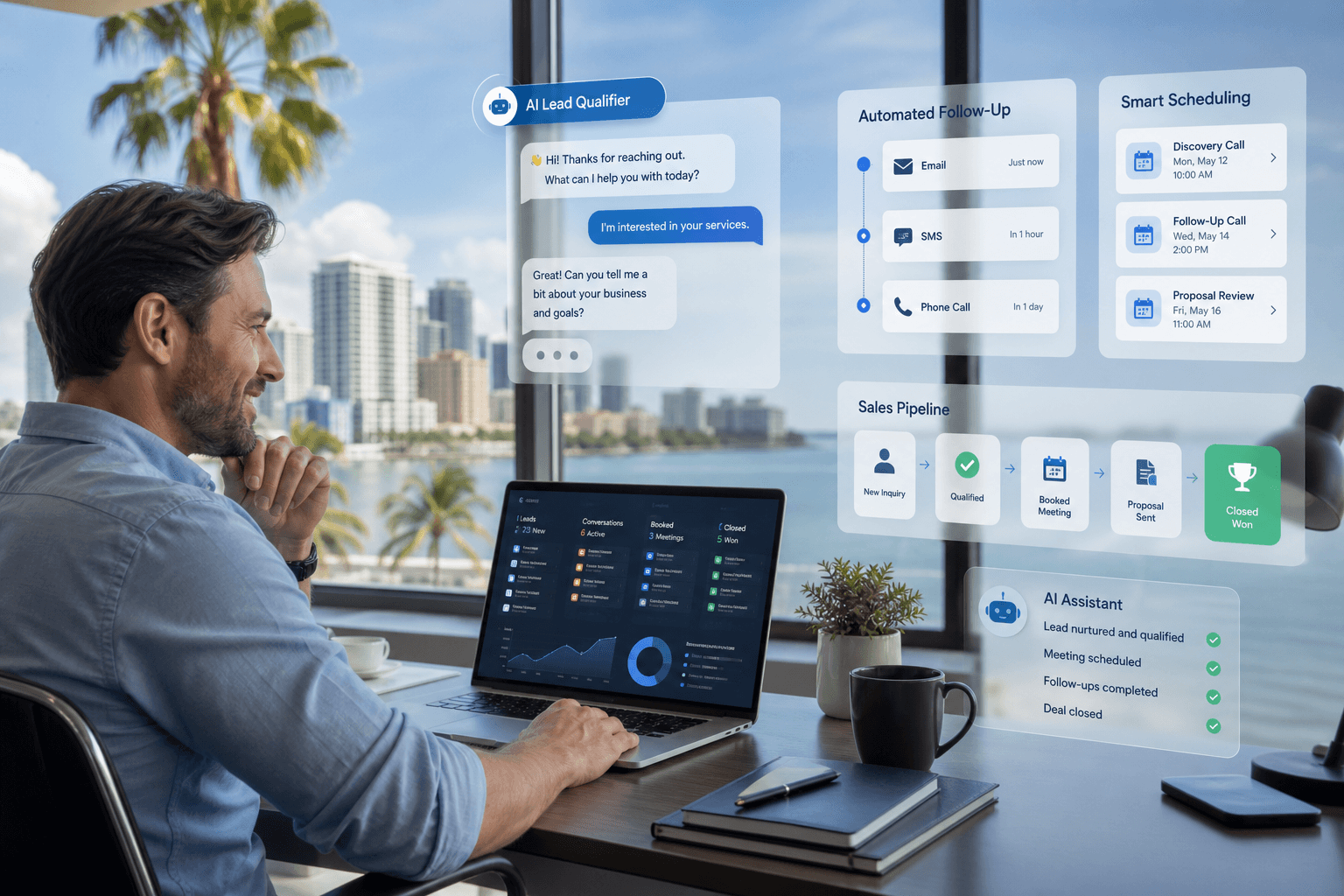
The post compares AI chatbots, AI agents, and automated workflows for small businesses. It uses simple analogies to explain that agents handle recurring, reviewable tasks autonomously, chatbots support live back-and-forth help, and workflows follow fixed rules.
It also outlines where each option works best and fails, then offers a decision guide for choosing the right tool based on task stability, need for judgment, and level of human oversight.

AI Chatbot vs AI Agent vs Automated Workflow:
Which “Driver” Does Your Business Actually Need?
A plain-English breakdown for small business owners, operators, and entrepreneurs
Everyone is talking about AI right now. But here’s the thing most people miss: not all “AI” is the same thing. There’s a massive difference between an AI chatbot you type questions into, an AI agent that actually goes and does things for you, and an automated workflow that blindly follows a script.
Using the wrong one for the wrong job is like hiring a GPS navigation system to drive your car — or worse, letting a new driver loose on the highway without a co-pilot.
This post breaks all three down in plain English, shows you exactly when each one shines (and when it fails), and gives you a simple decision guide at the end so you always know which “driver” to call.
The Three Drivers: A Quick Analogy
Before we get into definitions and decision frameworks, here’s the fastest mental model you’ll ever need:
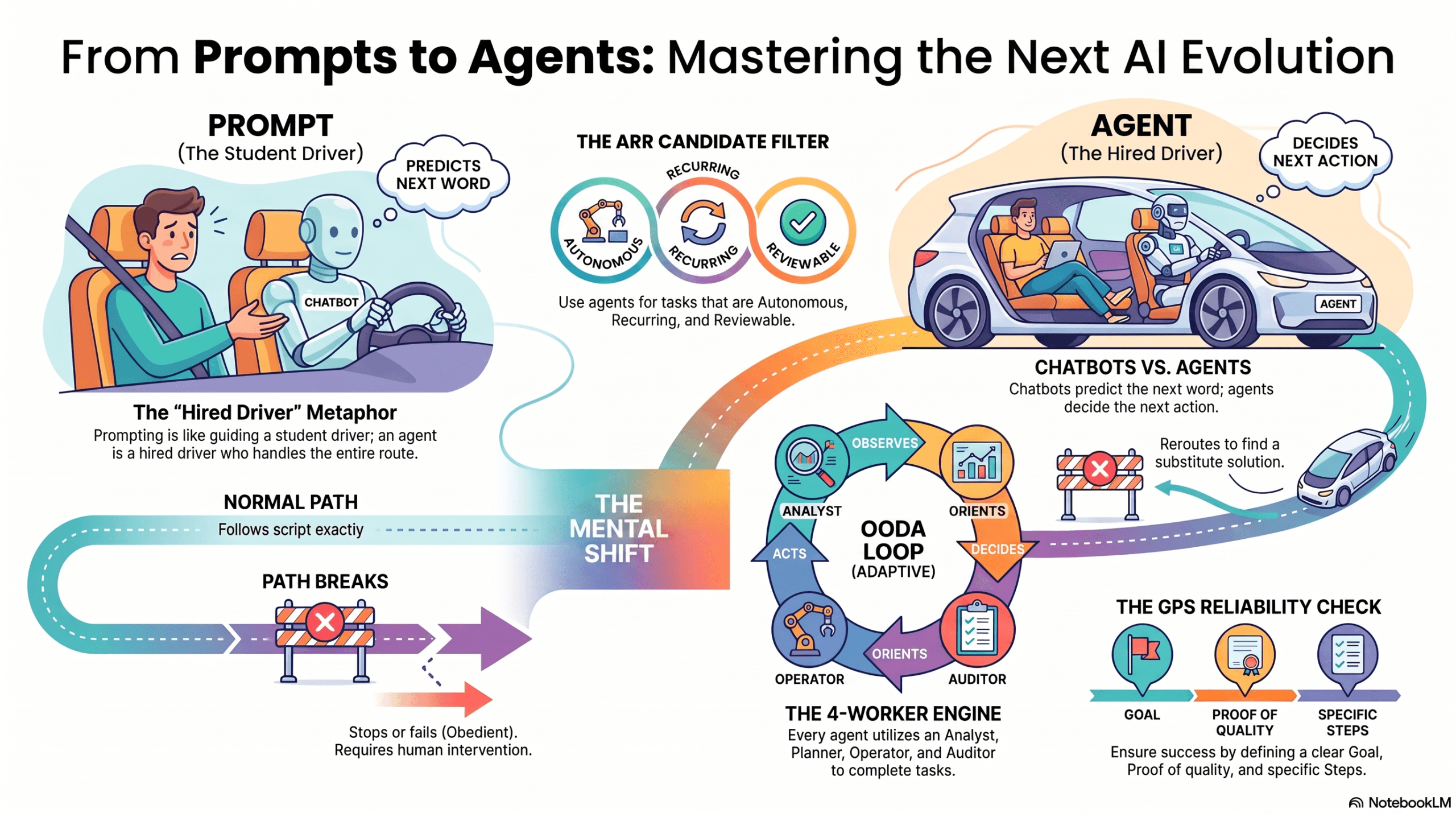
| AI Agent = Hired Driver. You tell them your destination, hand over the keys, and they figure out the best route, reroute around traffic, and handle any surprises along the way.AI Chatbot = Student Driver. It can move the car, but only if you’re sitting in the passenger seat giving constant feedback and corrections.Automated Workflow = Obedient Script. It’s like a driver following a printed turn-by-turn list — fast and reliable on a clear road, completely useless if the road is closed. |
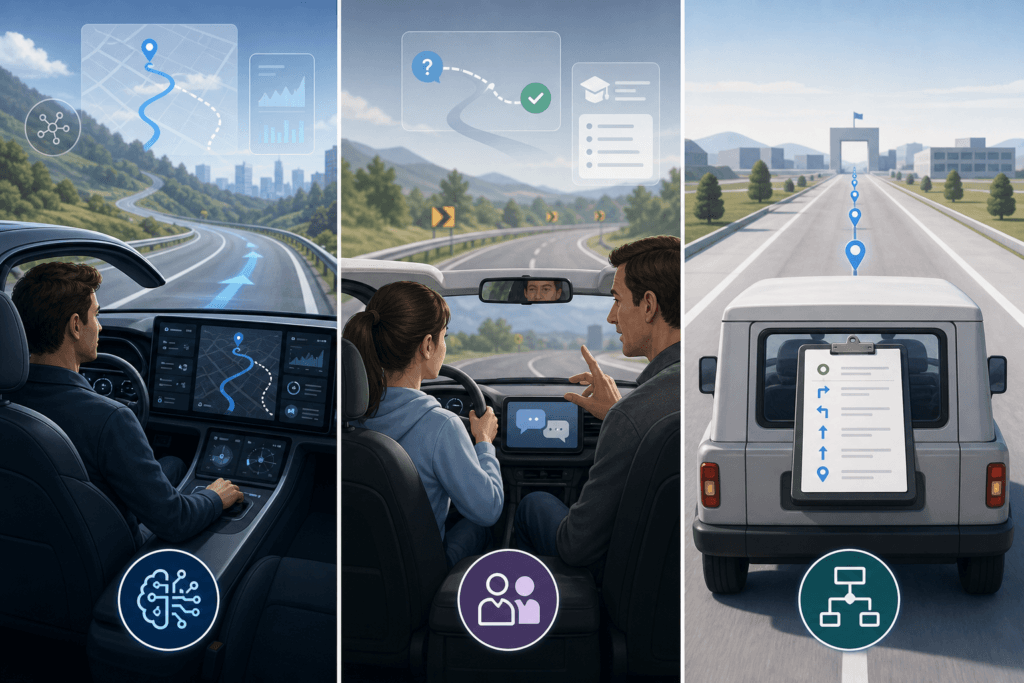
Keep those three images in your head as we go deeper.
What Is an AI Agent? (And Why It’s Different)
An AI agent is a goal-driven system. You give it an objective — “Monitor our website traffic, write a weekly summary report, and flag anything unusual” — and it goes to work autonomously. It can call APIs, use tools, adapt its plan when things change, and deliver results without you babysitting every step.
The ARR Framework: What Makes Something a True Agent
A useful way to identify a real AI agent is the ARR test. An agent is:
- Autonomous — It chooses its own next action. You set the goal; it figures out how to get there.
- Recurring — It runs on a schedule or trigger, not just when you ping it.
- Reviewable — Its steps and outputs can be audited. You can look back and see exactly what it did and why.
If any of those three are missing, you’re probably looking at a chatbot or a workflow, not a true agent.
How an Agent “Thinks”: The UODA Loop
Most AI agents operate on something close to this cycle under the hood:
- Observe — Gather data from tools, APIs, memory, or external sources.
- Orient — Understand the current situation relative to the goal.
- Decide — Choose the next best action.
- Act — Execute it, then loop back to observe.
Think of it like a pilot checking instruments, interpreting the readout, deciding on a course correction, and executing — over and over, automatically, until the plane lands.
Where Agents Fail
| ⚠️ The #1 Agent Failure Mode: Formalizing Bad Thinking Agents amplify whatever goal you give them. If your goal is vague or wrong, an agent will confidently and autonomously execute the wrong plan across dozens of steps before anyone notices. Garbage goal in, garbage at scale out. |
What Is a Traditional AI Chatbot?
A chatbot is the AI you’re probably most familiar with. You type something, it types back. It’s optimized for conversation — answering questions, generating ideas, summarizing content, helping you draft emails.
Under the hood, it’s mostly predicting the most useful next word given your prompt and the conversation history. That makes it incredibly good at reactive, in-the-moment tasks. It does not make it great at owning a complex process end-to-end on its own.
Where Chatbots Shine
- Quick Q&A and research lookups
- Brainstorming and ideation sessions
- Drafting content with a human in the loop
- Customer support triage where a human reviews and escalates
- One-off tasks that need live human judgment
Where Chatbots Fail
| ⚠️ The #1 Chatbot Failure Mode: Glorified Search Without long-term memory, clear reviewable outputs, or the ability to independently use tools, a chatbot gets stuck answering within the immediate conversation window. It can’t reliably own a complex multi-step process — it needs you to hold its hand the whole way. |
What Is an Automated Workflow?
An automated workflow is a deterministic script. Built with tools like Zapier, Make, or custom code, it follows a predefined sequence: if X happens, do Y, then do Z. There’s no reasoning, no adaptation, no “Wait, something changed, let me rethink.” It just runs.
And honestly? For the right job, that’s exactly what you want. Workflows are fast, cheap, reliable, and completely predictable — as long as nothing unexpected happens.
Where Workflows Shine
- Invoice paid → send confirmation email → update CRM
- New lead in form → add to email list → notify sales rep
- Daily backup → compress files → upload to cloud storage
- Any stable process with identical inputs and unchanging steps
Where Workflows Fail
| ⚠️ The #1 Workflow Failure Mode: Brittleness The moment the real world doesn’t match the script — an API changes, a calendar shifts, an edge case appears — a workflow stalls or misfires. It was never designed to rethink. It just obeys, until it can’t. |
Side-by-Side Comparison
| AI Agent | AI Chatbot | Automated Workflow | |
| Analogy | Hired Driver | Student Driver | Obedient Script |
| Decision Mode | Chooses its own next steps | Reacts to your prompts | Executes preset steps |
| ARR | Autonomous, Recurring, Reviewable | None (reactive) | Recurring only |
| Best For | Recurring, reviewable tasks | Live Q&A, brainstorming | Stable back-office processes |
| Failure Mode | Amplifies bad goals | Stuck in glorified search | Breaks on unexpected inputs |
| Requires Human | Goal-setting only | Constant guidance | Full pre-programming |
So Which One Do You Actually Need?
Here’s the quick decision guide:
| ✅ Choose an AI Agent when… The task repeats on a schedule and you want it to just happen.The process has multiple steps that might need to adapt based on results.You need a clear audit trail of what the AI did and decided.You’re okay setting a clear goal upfront and trusting the system to execute. |
| ✅ Choose a Traditional Chatbot when… You need a live back-and-forth conversation with a human in the loop.The task is one-off, exploratory, or requires judgment calls along the way.Results don’t need to be formally reviewed or audited.You want brainstorming, drafting, or quick answers — not autonomous execution. |
| ✅ Choose an Automated Workflow when… The process is completely stable — same inputs, same steps, same outputs every time.You don’t need reasoning, just reliable execution.You want the cheapest, fastest, most predictable automation possible.The environment rarely changes and edge cases are handled upstream. |
The Bottom Line
AI agents, chatbots, and automated workflows are not competing technologies — they’re different tools for different jobs. The businesses winning with AI right now aren’t the ones using the most AI. They’re the ones using the right AI for the right task.
If you’re building a local service business, an e-commerce operation, or a digital product and you’re wondering which “driver” to bring on board, start by asking: Is this task recurring, reviewable, and something I can hand off with a clear goal? If yes — you want an agent. If you need a conversation partner with human oversight — go chatbot. If the process is rock-solid and unchanging — build a workflow.
Most growing businesses end up using all three. The key is knowing which driver to call for which trip.
Want help building your first AI agent or automation system?
Drop a comment below or reach out — we help small businesses in St. Petersburg, FL and beyond get set up with AI that actually works.